1 min read
What is static electricity?
What is static electricity? Static electricity is a physical phenomenon caused by an imbalance of electric charges on a surface. Though often...
2 min read
Something on your production line feels off. Materials are behaving unpredictably. Sheets won’t separate smoothly, film starts misaligning, or labels suddenly refuse to feed consistently. At first glance, these issues may seem random or unrelated. But in many cases, there’s an invisible factor influencing the entire process: static electricity.
The challenge is that static electricity often goes unnoticed until it begins affecting quality, efficiency, or productivity. This is where most companies make their first mistake: they skip straight to the solution.
An ionising bar gets installed. Maybe things improve a little. Maybe they don't. Maybe the problem moves somewhere else. Without a baseline measurement, there's no way to know if the fix is actually working, or whether you were even treating the right spot.
Measuring static electricity isn't just a diagnostic step. It's the foundation of any effective static control strategy.
Static charge is one of the most frustrating process problems to troubleshoot, precisely because you can't see it. You can see its effects (misfeeds, jams, contamination, shocks, even fires in the wrong environment), but the charge itself is invisible. It has no colour, no smell, and it builds up silently on surfaces throughout your machine.
This is why instinct alone isn't enough. What feels like a problem "at the output" might actually originate three metres upstream. What seems like a grounding issue might be a charging problem caused by friction at a nip point. Without measurement, you're guessing.
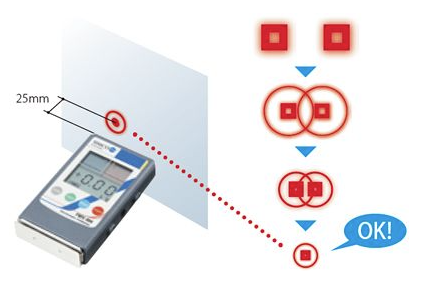
A static meter gives you two critical pieces of information: the magnitude of the charge (in kilovolts) and its polarity, meaning whether the surface is positively or negatively charged.
Both matter. A charge of +8 kV and one of -8 kV look identical to the naked eye, but they behave differently and require the same type of solution aimed in the right direction. Knowing the polarity tells you whether two surfaces will attract or repel each other, which is often exactly the behaviour causing your production headache.
Measurement also tells you where in the process the charge is highest. Running a handheld meter along the web path, or monitoring continuously with inline sensors, can pinpoint the exact source, which is almost never where operators initially suspect.
For initial investigations or periodic checks, a handheld static meter is fast and flexible. You can walk the line, probe different positions, and build a picture of where charge is accumulating and how it changes under different conditions.
For continuous production environments, especially high-speed web processes, inline measurement is the more powerful option. Sensors mounted across the web width give you a real-time view of charge distribution, and that data can be logged, trended, and fed directly into an active control system that adjusts ionisation automatically.
The right choice depends on whether you need a snapshot or a continuous window into your process. Many operations benefit from both: handheld measurement to map the problem initially, and inline sensing for ongoing process control.
One more reason not to skip this step: it's the only way to verify that your solution is actually working.
After installing static eliminators, a follow-up measurement tells you immediately whether charge levels have dropped to an acceptable range. If they haven't, you know to look further. If they have, you have documented proof, useful for quality records, customer requirements, or simply for your own peace of mind.
Static control without measurement is a bit like adjusting the heating without a thermometer. You might get comfortable eventually, but you'll never really know why.
Simco-Ion offers both handheld and inline static measurement solutions. If you're unsure where to start, our team is happy to help you map your process and identify the right measurement approach for your application.
-1.png)
1 min read
What is static electricity? Static electricity is a physical phenomenon caused by an imbalance of electric charges on a surface. Though often...
-1.png)
1 min read
Five productions problems almost always caused by static (and how to recognize them) Static electricity is a common but often overlooked cause of...
-1.png)
1 min read
Comparison explainer | Ionising bars vs Closed-loop feedback systems In many production environments, static is not a constant. It shifts with...